The main difference is how the product compartment is created. Blister packaging uses preformed cavities, while strip packaging seals two flexible webs around individual products without a separate cavity-forming step. The choice depends on product protection, opening method, material compatibility and production requirements.
Blister cavities may be thermoformed from suitable plastic films or cold-formed from aluminium-based laminates. The product is placed in the preformed cavity and sealed with a compatible lid.
The table below sets the two formats against the criteria that decide most projects: structure, material, protection, opening and changeover.
| Criterion | Blister packaging | Strip packaging |
|---|---|---|
| How the dose is held | Preformed cavity, thermoformed from plastic film or cold-formed from aluminium-based laminate, sealed with a compatible lid | Two flexible webs heat-sealed around each product, no cavity-forming step |
| Material set | PVC, PVDC-coated PVC, PET, PP, cold-form alu-alu film plus lidding foil | Flexible heat-sealable foil laminates or plastic films, selected for the product and the sealing process |
| Barrier ceiling | Moderate on PVC, high on alu-alu or tropical foil | High on foil laminates, set by layer structure, seal integrity and pinhole count |
| Product protection | Cavity holds the dose in a fixed position and shields it from mechanical damage in transit | Flat seal holds the dose between webs; protection follows the laminate and seal width |
| Printed information | Full print area on the lidding foil, subject to artwork and registration | Webs can be printed; usable area is set by artwork layout and registration capability |
| Opening method | Push-through, peelable or peel-push, depending on lid design | A specified tear, peel or other access feature; perforations may separate individual units without opening them |
| Output unit | Plates per hour | Strips per hour, cut from one or more lanes |
| Changeover | Forming mold, seal pattern and punch tool per layout | Seal contour and cut tool per dose size, no forming mold to cut |
| Product thickness | Bounded by forming depth on that model | Bounded by web width and seal contour |
Both formats can carry printed product information, subject to usable surface area, artwork layout and registration capability. Strip packaging can be printed on its webs, and the required labelling location has to be determined for the product and the market rather than assumed from the format. A layout with more available surface does not automatically mean more usable print, because artwork, registration and pack size decide what can actually be placed where.
If you would rather compare the two formats on your own dose than on a table, send the product type and target output. We return the model match, a tooling drawing, photographs of that configuration, a running video and a feasibility assessment against your sample, and the message field is the place for doses per card or strip, target output per shift, preferred material and available floor space.

What is the difference between strip and blister packaging?
Blister cavities may be thermoformed from suitable plastic films or cold-formed from aluminium-based laminates. The product is placed in the preformed cavity and sealed with a compatible lid. Strip packaging has no cavity-forming step at all: two flexible webs seal flat around the product, and the finished strip separates at perforations.
Cavity forming versus flat sealing
The two processes diverge at the first station, and everything downstream follows from that.
Blister sequence:
- 1a. Thermoforming route: a plastic film such as PVC, PVDC-coated PVC, PET or PP is heated and drawn into a mold by vacuum, pressure or plug assist. Cavity depth and wall thickness come from the film’s elongation and the mold.
1b. Cold-forming route: an aluminium-based laminate is stamped between a punch and a die at room temperature, and the cavity comes from the laminate’s elongation rather than from heat. This route needs a forming station set up for cold-form film, so it is confirmed per model rather than assumed across a family. - Product drops into the cavities through a channel or vibratory feeder while a missing-tablet sensor checks each plate.
- A heated seal plate or roll presses the lidding foil onto the web, bonding only along the seal pattern.
- Batch data is embossed, the card is creased where the format folds, and the punch tool cuts the plate outline.
Strip sequence:
- Two webs feed in parallel, printed face out or plain, under tension held by a servo or mechanical dancer.
- Product is placed into the pocket described by the seal contour, usually on a drum or a flat platen.
- A heated roll seals the webs around each dose, so the seal geometry replaces the mold.
- Perforation and cross-cut tools separate strips while leaving a tear line.
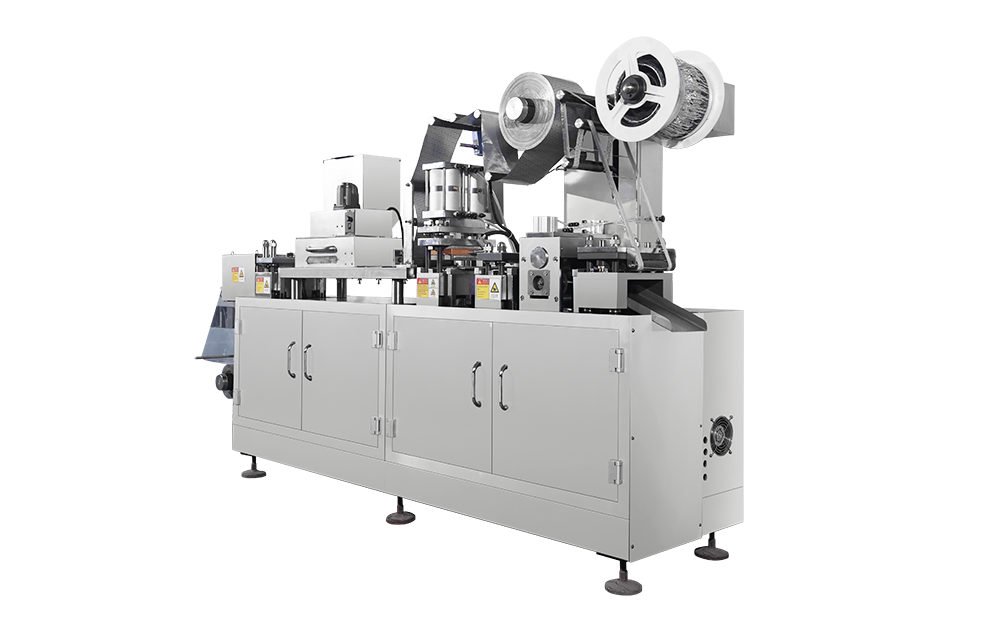
Tooling follows the same logic. A thermoformed card needs a forming mold, a seal pattern and a punch tool per layout; a cold-formed card replaces the mold with a forming die, while the seal and punch tools still change with the layout. SED’s SED-TP-B page states a complete tooling change across forming, sealing, batch coding, creasing and punching can be done in 15 minutes without tools, which is the practical ceiling for a format built on removable molds. A strip line needs a seal contour and a cut tool per dose size, but no forming mold to cut and no cavity depth to match, so a strip changeover usually costs less time even where the tooling count is similar.
What is strip packaging, and which products belong on a strip line?
Strip packaging encloses single doses between two flexible webs, seals them flat and perforates between doses so each unit tears off without opening the rest of the pack.
How an aluminium strip is built
Aluminium strip packs use flexible, heat-sealable foil laminates selected for the product and the sealing process. These materials should not be assumed to be interchangeable with cold-form blister laminates, and the full layer structure, thickness and sealant specification have to be confirmed for the application. Romaco’s notes on heat sealing for effervescent products are a useful reference on how far seal behaviour depends on the laminate and the sealing conditions rather than on the machine alone.
Two consequences follow for anyone specifying a strip line. First, pinholes in the foil defeat the barrier no matter how good the seal is, so inline pinhole detection is worth costing at quotation stage rather than after commissioning. Second, the access feature decides whether patients can open the pack; a tear line that needs scissors fails the same usability test that a hard-to-push blister fails.
Products that should not go on a blister line
Four product types are better served by a strip or a tube than by a cavity:
- Effervescent tablets, where the dose is thick, fragile and needs a foil barrier, and the cavity would add nothing. SED builds a dedicated effervescent tablet packing range for this group.
- Single-dose powders and granules, which cannot be held in a thermoformed pocket without spillage during sealing.
- Tablets thicker than the forming depth of the model under consideration. Depth is model-specific rather than a family feature: the SED-GP-E range is published at 12 mm, the SED-P-F at 35 mm and the SED-P-A at 50 mm.
- Very large or irregular shapes that would need a separate mold per variant without adding barrier benefit.
Choose a strip line when the dose is flat, a flexible laminate barrier is acceptable and the annual volume does not justify a forming mold per SKU. Ask us to evaluate a blister format when the pack needs cavity protection against mechanical damage in transit, or an opening style that a flat-sealed strip cannot provide. Ask us to evaluate a blister format when the pack needs cavity protection against mechanical damage in transit, or an opening style that a flat-sealed strip cannot provide.
What is blister packaging made of, and how does material choice change cost and barrier?
Blister packaging pairs a thermoformable plastic web with a lidding foil, and the plastic side sets both the barrier level and the largest share of material spend.
PVC and PVDC-coated PVC
SED’s SED-TP-B specification lists non-toxic rigid PVC film from 0.15 to 0.5 mm and coated PTP aluminium foil from 0.02 to 0.035 mm, both at 270 mm width, with reel cores of 70 to 76 mm. PVC is the default for tablets and capsules sold in moderate-humidity markets with shelf lives that do not demand a foil barrier. It forms easily, runs at high stroke rates and keeps material cost low. A PVDC coating raises moisture barrier without changing forming behaviour much, at the cost of a harder recycling route.
Alu-alu and tropical foil
The same SED-TP-B page also lists tropical aluminium at 0.09 to 0.15 mm, and the P and GP families are described for ALU-ALU work. Cold-form alu-alu film is stamped rather than heated, so cavity depth comes from the foil’s elongation and the material returns a near-total moisture and light barrier. For a fuller breakdown of where the two material systems part company, see this comparison of Alu-Alu vs. PVC blister packaging.
| Material | Moisture barrier | Light barrier | Forming method | Recycling route | Consider it when |
|---|---|---|---|---|---|
| PVC | Moderate | Transparent | Heated vacuum or pressure | Limited, PVC and foil must be separated | Short shelf life, cost-led, moderate humidity |
| PVDC-coated PVC | Good | Transparent | Heated vacuum or pressure | Limited, coating complicates separation | Better barrier needed without changing the line |
| PET or PP | Moderate to good | Transparent | Heated | Better in polyolefin or PET streams | Sustainability targets dominate the brief |
| Tropical aluminium | High | Opaque | Heated with a foil-capable seal set | Aluminium stream | Humidity is the main stability risk |
| Cold-form alu-alu | Very high | Opaque | Stamped | Aluminium stream | Moisture-sensitive or oxygen-sensitive product |
The table is a general comparison of material systems, not a specification of any single SED model. Final material choice has to be confirmed against your stability data and the registration file for each market.
On compliance, SED equipment is described as designed to meet GMP requirements for the forming, filling and sealing stages. Whether a given installation is compliant depends on the room, the validation work and local regulation, and material certificates, surface finish records and validation documentation can be supplied with a quotation on request.

How much output do you need? Matching format to machine class
Output decides machine class more than format does, because the same blister format can run at 1,800 plates per hour on a deep-draw unit and up to 14,400 on a roller-plate unit.
Reading plates per hour and strips per hour correctly
Published rates are nominal, and three conversions sit between that number and a carton count.
- Plates to doses: multiply plates per hour by doses per card. A 10-dose card at 8,400 plates per hour is 84,000 doses per hour.
- Doses to cartons: divide by cards per carton.
- Nominal to sustained: apply your own efficiency figure. At 75 percent of the published SED-TP-B rate of 140 plates per minute, the sustained figure is 105 plates per minute, or 6,300 plates per hour. The 75 percent is an arithmetic assumption for illustration, not a performance guarantee; your real figure depends on shift pattern, changeover frequency and downstream cartoning.
Strip output is counted differently. Strips per hour depends on cut frequency and lane count, and the published cut frequency differs across the SED-RP-F models, so strip capacity has to be confirmed for the specific model rather than assumed from the family name.
SED model families by throughput
SED’s blister packing machines are grouped by forming method, and the group you land in is set by cavity depth and stroke rate rather than by price band.
| Model | Format | Published output | Forming envelope | Choose this when | Quotation basis |
|---|---|---|---|---|---|
| SED-P-F | PVC/ALU, paper/PVC, ALU/ALU | 1,980–9,600 plates/hr | 310 × 160 mm, depth 35 mm | Several SKUs on one line, mid volume, cavities a roller machine cannot reach | Model, tooling set, inspection scope |
| SED-P-A | Thermoform, deep draw | 1,800–3,000 plates/hr | 390 × 150 mm, depth 50 mm | Large tablets or capsules where depth rules out a 12 mm roller machine | Model, tooling set, inspection scope |
| SED-TP-B | PVC/ALU | 8,400 plates/hr | 260 × 110 mm | Steady single-SKU runs, tight floor space, weekly rather than hourly changeover | Model, tooling set, material spec |
| SED-GP-E | PVC/ALU, ALU/ALU, roller plate | 9,000–14,400 plates/hr | 180 × 210 to 240 × 320 mm, depth 12 mm | Volume is the constraint, cavities are shallow, long campaigns | Model, tooling set, line integration |
| SED-RP-F | Strip, flexible foil laminate | Confirm per model | Web width 160, 250 or 350 mm | Flat dose, flexible laminate barrier, no cavity needed | Model, seal contour, cut tool |
Two things are worth reading off this table before the numbers. Depth separates the families more sharply than speed does: a 12 mm roller machine and a 50 mm deep-draw unit are not alternatives for the same tablet, whatever the plate rates say. And the SED-TP-B footprint of 5,360 × 850 × 1,750 mm at 4,000 kg is the figure to check against your room before the tooling discussion starts.
SED has built packaging equipment for 13 years from a 5,500 square metre facility with more than 100 staff and over 20 patents, and reports 600-plus machines delivered to 180 pharmaceutical companies in more than 20 countries. That matters less as a credential than as an indication of how many tooling layouts the team has already run, which shortens the path from sample to sealed card.
What drives the price of a blister or strip line
Price tracks four things: forming method, how many tooling sets you need, how much inspection you specify, and how much of the line you buy at once.
Tooling and changeover
Every layout needs its own tooling. A buyer with twelve SKUs is not buying one machine, they are buying one machine and twelve tooling sets, and the second part is often the larger number. Tooling count is also the reason a low-volume, high-variety buyer should compare strip and blister on changeover time rather than on nominal speed.
Inspection, rejects and line integration
Vision inspection, pinhole detection, checkweighers and serialisation stations each add capital and each add validation work. Specifying them at quotation stage costs less than retrofitting, because the reject gate and the reject confirmation logic have to be designed into the discharge.
Material consumption per unit
The forming area caps how many cards fit per stroke. A layout that leaves dead web raises material cost per dose without raising output, and on alu-alu film that waste is expensive. Card layout is therefore a cost decision, not only a design decision.
SED quotes per configuration rather than publishing a list price, because the same model with different tooling, inspection and interface scope is not the same machine. A quotation that is comparable line by line is worth more than a low number with the scope left open.
Before you request a quote: samples, trials and line interfaces
A quotation is only meaningful when it is tied to a trial, because the same format can pass on one tablet and fail on another with a different coating, shape or fill weight.
Prepare these before contacting a supplier:
- Product type, dose count per card or strip, and whether the card folds.
- Target output per shift and per year, with the shift pattern.
- Preferred material, or the barrier level your stability data requires.
- Available floor space, ceiling height and the proposed line direction.
- Upstream and downstream interfaces, including whether the plates feed a cartoning machine or a case packer.
- Utilities available on site. The SED-GP-E range, for example, is published at 0.5 to 0.7 MPa air pressure with 0.2 to 0.4 cubic metres per minute consumption and cooling water at 0.1 to 0.25 MPa, while the SED-TP-B lists mould cooling at 60 litres per hour.
A trial resolves the questions a specification sheet cannot: Whether the tablet sits flat at speed, whether the seal holds on a coated surface, whether the access feature opens cleanly, and whether the punch tool marks the foil. We return a model recommendation, the tooling drawing, a material specification sheet, photographs of the machine you would receive, a running video and a written assessment of your sample against the proposed configuration.
Put those details in the message field when you send your name, email and phone, and the reply will cover the model, the tooling, the utilities and the schedule in one pass rather than four.
Summary
Blister and strip packaging answer the same unit-dose question with different physics. Blister buys cavity protection, a full print area on the lidding foil and high plate output at the cost of a mold per layout. Strip buys a flexible laminate barrier and short changeovers at the cost of the cavity. The decision usually turns on cavity depth, barrier requirement and SKU count, not on nominal speed, because a machine that runs fast but needs a new mold for every variant will lose to a slower one that changes over in 15 minutes. Match the model to the dose first, then to the volume, and confirm both on a trial with your own sample.
FAQ
Can one machine run both blister and strip formats?
Not by swapping tooling alone. Blister needs a forming station, a vacuum or pressure system and a mold; strip needs a flat seal arrangement and no forming station. Some alu-alu capable machines can run flat-sealed work within their web width, but the capability is model-specific, so it has to be confirmed against a named model rather than assumed from the format description.
Which format costs less per unit at low volume?
At low volume the tooling count usually dominates rather than the material. A twelve-SKU range on blister means twelve molds, while a strip line needs a seal contour and a cut tool per dose size and changes over faster. The comparison only becomes meaningful once both options are quoted against the same SKU list, output and inspection scope.
Is strip packaging suitable for moisture-sensitive tablets?
An aluminium laminate strip provides a high barrier, and the weak points are seal integrity and pinholes rather than the material itself. Whether it is sufficient depends on the stability data and the shelf life required in each market. For products where humidity is the main degradation route, an alu-alu blister and an alu strip should both be evaluated against the same stability protocol before the format is fixed.