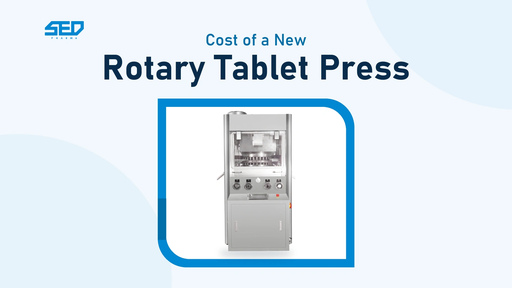
Tablet manufacturing machine price is set by machine class, not by the words on an inquiry form.
Tablet press prices vary by machine class and by what the supplier includes. This guide compares new single-punch and rotary presses for the compression step. When comparing quotes, separate the press price from tooling, documentation, freight and installation.
Granulation, coating and packaging stay outside it unless they change what the press has to do. A single punch press usually runs below $5,000 for a one-station machine, a small or medium rotary press $8,000 to $30,000, and a pharma-grade high speed rotary above $30,000, per a 2026 market price guide checked on 23 November 2026. Here is where the money goes.
The first table gives indicative market ranges by machine class. SED provides configuration-specific quotes.

What a tablet press machine costs by machine class
Price follows stations, force rating and paperwork, which is why the market quotes five separate ranges instead of one number. The ranges below come from a 2026 tablet making machine price guide published by a press supplier (noahtabletpress.com, checked 23 November 2026). They describe new machines before freight and installation, and work as market anchors rather than a SED price list.
| Published range | Machine class | What the money covers | Main price driver |
|---|---|---|---|
| $500–$3,000 | Manual single punch | One station, hand wheel or lever, one tooling size | Nothing automated |
| $1,500–$5,000 | Electric single punch | Motor driven, automatic ejection, one tooling size | Motor, feed and ejection |
| $3,800–$8,000 | Mini rotary, 5–9 stations | Small rotary frame, compact turret | Station count, turret size |
| $8,000–$30,000 | Standard rotary, 19–29 stations | Production frame, force feeder, basic monitoring | Force rating, controls |
| $30,000–$150,000+ | High speed and GMP rotary, 45+ stations | Enclosed turret, pressure sensors, document set | Compliance file, speed, automation |
Two ranges overlap at the boundary, and that overlap is real: a well-equipped electric single punch machine can cost more than a stripped-down nine station rotary. The class matters more than the last thousand dollars.
Where the entry class stops
Single punch machines make one tablet per stroke, so output tracks how fast an operator can feed and clear the machine. Buyers here are formulators, clinics and small brands running a first stability batch. The price does not usually cover forced feeding, in-line weight monitoring, or a turret carrying more than one tooling size. That is the right trade for development work and the wrong one for a product going to market at volume.
Where the middle of the market sits
Five to twenty-nine station rotary presses carry most commercial supplement and generic production. The money over an entry machine buys a turret, a force feeder that keeps the die table full at speed, and enough stations that output stops depending on the operator. This class is also where quotes diverge most, since two machines with the same station count can differ in frame rigidity and controls. SED’s Y series sits here, from 6,000 to 190,000 pcs/hr, and the tablet press machines category page sets the four classes side by side.
Where the top of the market starts
Above thirty stations the machine changes character. The turret is enclosed, the working zone is separated from the drive, pressure sensors report force in real time, and the supplier hands over a documentation set rather than an operating manual. The rest of the money buys the file that lets a quality team qualify the equipment and a customer audit accept it.
Why the same capacity gets quoted at different prices
Two machines can share a capacity figure and share almost nothing else, so a quote has to be read line by line rather than by the headline number. Public listings show the spread: asking prices for machines sold under tablet making machine keywords on made-in-china.com ran from $325 to $200,000 across the listings reviewed on 23 November 2026, and several of those entries were blister packaging machines filed under the same keyword. Some of that gap is real capability.
| Quote line | What a low quote often means | What to confirm before comparing |
|---|---|---|
| Tooling | One tablet size, or tooling excluded | Whether a complete punch and die set is inside the price |
| Contact parts | Standard stainless, no paperwork | Material grade and whether mill certificates come with it |
| Force rating | Rated at the small end of the tablet range | Force rating against your largest and thickest tablet |
| Controls | Relay logic, analog gauges | Whether weight, force and speed are monitored or logged |
| Documentation | Operating manual only | IQ/OQ support, surface finish records, material traceability |
| Spare parts | Wear parts only | Which parts ship with the machine and which are consumables |
| Freight and installation | Ex-works, buyer arranges | Who pays freight, who commissions, who trains operators |
| Warranty scope | Parts only, short window | What the warranty covers and what voids it |
Tooling needs its own line in any comparison. Punches and dies are consumables priced per size, and a full set for a high station count turret is a purchase in its own right.
Single punch or rotary: the decision that sets your budget
Below roughly 5,000 tablets an hour, a single punch press is normally the cheaper path; above it, a rotary press spreads tooling and labor across enough output to change the cost per tablet. SED’s published ranges mark that line without stating it: single punch models run 1,200 to 5,000 pcs/hr, and the smallest rotary model starts at 6,000.
When a single punch setup is enough
A single punch press fits when batches are small, shapes change often, and one person can run the machine. Clinical supply, stability batches and customer samples all sit there. Setup is quick, the footprint is small, and a second tooling size costs far less than a second turret. The limits are as clear: one tablet per stroke, and a weight consistency that depends on how evenly the die fills.
When rotary output pays
A rotary press makes sense once the product is fixed and the volume predictable. Multiple stations fill, compress and eject continuously, so output stops tracking the operator. The cost structure changes with it: tooling is bought per station, changeover takes longer, and a small setup error repeats across every station. For a product running three shifts, labor per thousand tablets is usually what justifies the price.

How a rotary tablet press machine forms a tablet
A rotary press does four things in a continuous circle: fill the die, meter the fill depth, compress the powder between two punches, and eject the tablet. The steps below show where the feeder, compression controls and tooling come into play. Those options can change the price of the press.
The die table rotates under a feed frame, and powder drops into each die by gravity, assisted by a force feeder on larger models. The lower punch position sets die volume, and because weight is set volumetrically, fill depth is the weight control. Punches then pass between compression rolls that apply force, and a cam lifts the lower punch to eject the tablet. Weight holds only if powder flows consistently into the die, which is why particle size and moisture decide whether a press runs well on a formulation.
Changing product is not a button. Fill depth, force, turret speed and feeder settings move together, and a machine that ran cleanly on one granulation can produce capping or sticking on another at identical settings. Some configurations add a pre-compression roll that squeezes air out before main compression. On SED’s range that is a model-level configuration, so confirm it for the model being quoted.
Reading SED’s published model data
The published table separates the range by output first and tablet size second, so model choice starts with the output you need at the size you actually press. Two models in one series can publish very different capacity ceilings on the same tablet diameter.
Use the model table below to compare published output and check which presses can handle your tablet size.
| Model | Capacity (pcs/hr) | Published specification | Typical use | How it is quoted |
|---|---|---|---|---|
| SED-GY-B | 30,000–675,000 | 29–75 dies; tablet diameter 11–25 mm | High speed production across industries | Per configuration |
| SED-GY-D | 43,000–405,000 | 10–57 dies; tablet diameter 11–25 mm | High speed production across industries | Per configuration |
| SED-Y-B | 6,000–190,000 | 13–50 dies; tablet diameter 13–50 mm | Mass production of various tablet shapes | Per configuration |
| SED-Y-D | 14,400–170,000 | 8–45 dies; tablet diameter 13–40 mm | Mass production of various tablet shapes | Per configuration |
| SED-DY-E | 4,500–5,000 | Tablet diameter 12–20 mm; manual or automatic | Small scale production | Per configuration |
| SED-DY-D | 1,200–5,000 tablets/hour | Tablet diameter 12–25 mm | Small scale production | Per configuration |
| SED-HY-D | 1,200–1,500 | Working pressure: 6‑80 T; loading height: 40‑60 mm; SED‑6HY‑D: 40 mm loading height, 6 T working pressure; SED‑60HY‑D: 60 mm loading height, 60 T working pressure | Industrial tablets, corrosive materials | Per configuration |
The comparison covers the models currently listed on our website.
The GY series shows the pattern. SED-GY-B publishes 30,000 to 675,000 pcs/hr on 29 to 75 dies, SED-GY-D publishes 43,000 to 405,000 pcs/hr on 10 to 57 dies, and both cover 11 to 25 mm tablets. Station count and diameter trade off inside one model, so the useful question is which diameter a published station count applies to, and whether your tablet sits inside it.
The Y series covers the middle, at 6,000 to 190,000 pcs/hr on 13 to 50 dies, with diameters from 13 to 50 mm. That width makes it a general purpose class: one frame covers a 13 mm vitamin tablet and a 50 mm tablet a high speed press would struggle to place. The DY and HY models publish in hundreds to low thousands per hour, and the SED-6HY-D has a 40 mm loading height and a working pressure of 6 T. The SED-60HY-D has a 60 mm loading height and a working pressure of 60 T.
What to send us before we can price your machine
Three variables set the first quote: the tablet you need to make, the output you need per shift, and how the powder behaves on a press. Everything else is adjustment.
The inquiry form asks for four fields, name, email, phone and message. Nothing more is required. What shortens the evaluation is what goes into the message.
- Output required per shift, and how many shifts the line will run.
- Tablet specification: diameter or shape dimensions, target weight, single layer or multi-layer.
- Material notes: free flowing, sticky, abrasive, or high dose with a low active percentage.
- Equipment either side of the press, so the quote accounts for feed and discharge height.
- Whether a sample trial is possible, since a compression test on your granulation settles more than any specification sheet.
Send those four fields and we will come back with the model class that fits, the published specification for that model, photographs of the actual build, a running video, and an assessment of whether your formulation will press on that configuration. If you need material certificates or the verification file list before deciding, say so in the message.

Where the press sits in your line
A press quote covers the press, while the machines either side set the conditions under which the press meets its specification. The same model performs differently in two plants for that reason.
Upstream, granulation and mixing decide whether powder flows into the die at a consistent density, and no press corrects a granulation that segregates in the hopper. Downstream, a tablet deduster removes surface dust before coating or counting, because dust carried into the pan ends up under the film. Metal detection and weight checking sit between press and packaging, and where they sit changes the reject handling you need.
Coating adds a requirement buyers often miss. Tablet coating puts mechanical stress on the core, so hardness and friability must stay within the window the press sets. A tablet pressed at the low end of its force range can pass the press check and fail in the pan. Anyone planning a full tablet manufacturing line should size the press against the coated tablet, not the core.
What a SED quote contains
A quote from us is built from the configuration, so it can be compared line by line with another supplier instead of taken as a single number. It lists the host machine and its published capacity, the tooling scope, the parts that ship with it, the documentation package, and the installation and training terms. SED builds tablet presses at a 5,500 m² facility, and publishes 20+ patents and more than 300 cooperating companies on its site (sedpharma.com, checked 23 November 2026).
Tell us the tablet, the output and the material. We will tell you which class fits, what it costs for your configuration, and what we can show you before you commit.
FAQ
Does the price include punches and dies?
Usually not, and it depends on the supplier and configuration. Ask whether the quote covers a complete set for one tablet size or excludes tooling entirely, then price a second set for any additional size. Tooling is a consumable with a working life, so it belongs in the operating budget too.
Can one press run several tablet sizes and shapes?
Yes, within the diameter and force limits published for that model, with a tooling set for each size. Changeover means swapping punches and dies and resetting fill depth and force, which takes longer on a high station count turret. A shape change costs more than a size change, because the tooling is specific to the profile.
Can the same machine press effervescent or herbal tablets?
It can when the force rating and contact surfaces suit the material and the room controls humidity. Effervescent blends are moisture sensitive and press differently from a standard granulation, while herbal extracts vary in flow and density between batches. Settle both with a compression trial on your own powder.