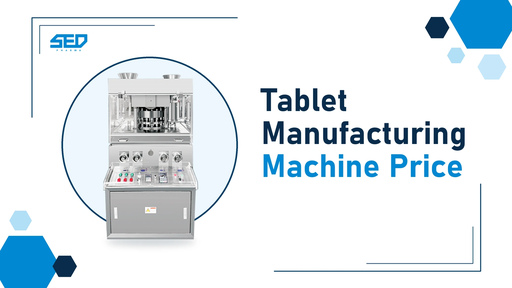
Budget a new rotary tablet press in two parts: the configured machine and the cost of getting it into production. Ask for tooling, freight, installation and qualification support as separate line items so you can compare quotes on the same basis. Tooling, freight, installation and validation arrive later. Budget the project, not the machine.
The cited IndexBox market analysis gives a planning range from US$20,000 for a basic single-sided rotary press to US$350,000 or more for a contained high-speed unit. SED quotes each machine after confirming the station count, compression force and tooling scope.
If your output is fixed, send the tablets per hour and the tablet size, and we’ll return a configured quotation, datasheets, build photos and a running video.

What a new rotary press costs before you configure it
To compare machine quotes, ask each supplier to price the same tablet size, target output and tooling package.
| Series | Typical stations | Output (tablets/hr) | Max tablet diameter | Max force | Fits | Quote basis |
|---|---|---|---|---|---|---|
| SED-Y-B | 7 to 45 dies | 6,000 to 190,000 | 13 to 50 mm | 60 to 130 kN | Routine single and double-sided runs | Quoted per configuration |
| SED-Y-D | 5 to 83 dies | 9,000 to 710,000 | 12 to 40 mm | 40 to 130 kN | Multi-shape, two-colour, engraved tablets | Quoted per configuration |
| SED-GY-B | 29 to 75 dies | 30,000 to 675,000 | 11 to 25 mm | Confirm per model | High volume with force feeding | Quoted per configuration |
| SED-GY-D | 10 to 75 stations | 43,000 to 675,000 | 11 to 25 mm | 80 to 100 kN | High volume, pressure monitoring | Quoted per configuration |
For the SED-GY-D series, the upper figures of 75 stations and 675,000 tablets per hour refer to the SED-660-75GY-D.
Ranges as published on the SED product pages, checked 23 November 2026. The GY-B page publishes no maximum force figure, so that cell is confirmed from the model sheet. The complete rotary tablet press range lists every model with its station count and output.
Where the money sits inside a rotary press
Four things separate a cheap quotation from an expensive one at identical output: turret and frame size, force rating, the feeding system, and what surrounds the compression zone. Rotational speed is rarely the main line.
Turret, station count and frame size
Station count sets turret diameter, bearing load and frame mass. A 7-die turret running fast and a 45-die turret running slowly can reach the same output and remain different machines. When a quotation looks low for a stated output, check which design is on the page.
Compression force, rollers and overload protection
Force rating decides the main shaft, the pressure rollers and the overload device. A 100 kN press has heavier structure than a 60 kN one at the same hourly output. Quietly lowering the rating is the easiest way to shave a quotation.
Gravity feed versus force feed
Gravity feeding is cheaper and suits free-flowing granules. Force feeding adds an impeller drive and change parts, and earns it when the material flows poorly, the turret runs fast, or fill weight must hold across a long run. Standard on one offer and optional on another means the prices aren’t comparable yet.
Enclosure, cleaning access and controls
Contact part grade, finish, seals, sensor count and the control platform all move cost, and so does access: a press that opens wide with no dead angles takes longer to design and cleans faster. Whether you need 316L or pressure logging depends on your product and market.
| Decision | What changes on the machine | Effect on the quote |
|---|---|---|
| 7 stations to 45 stations | Turret diameter, frame, drive | Up, and tooling multiplies by station count |
| 60 kN to 130 kN force rating | Shaft, rollers, overload protection | Up |
| Gravity feed to force feed | Feeder drive, impeller set, change parts | Up |
| General stainless to 316L contact parts | Material, welding, surface finish | Up |
| Open frame to fully enclosed with cleaning access | Panels, seals, drain points | Up |
| More stations slowly, or fewer fast | Same output, different cost balance | Depends on batch size |
Tooling is a separate budget line
Tooling is priced per station, not per machine. One set means one upper punch, one lower punch and one die, so a 45-station press needs 45 sets before it can run a single product.
This is where forecasts collapse. SED’s tooling listing starts at US$139.99 per set for TDP-format tooling and US$149.99 for RTP, with TSM and EU sets at US$249.99 on a five-set minimum (checked 23 November 2026, small-press formats). Forty-five sets of TSM tooling is a five-figure line on its own, and a second product needs another 45.
What pushes the number further:
- Shape. Round flat is cheapest. Deep concave, embossed logos and multi-tip punches add machining time.
- Coating. Hardened punches last longer between resets and cost more per set.
- Spares. One spare set for the shortest-life product keeps a weekend shutdown from becoming a week.
- Standard. TSM, EU and RTP aren’t interchangeable. The turret has to suit the tooling you already own.
Punches wear at the tip and head, dies at the bore, and a worn set shows up as weight variation before it shows as a defect. Our note on tablet press tooling maintenance covers what to inspect and how often, which is how you size the spare-set budget.

The landed budget after the machine price
The machine sits in the middle of the project budget, not at the top of it. Freight, duty, installation, documentation and spares sit on either side, and none appear in a headline quote unless you ask.
| Budget line | Who quotes it | How to size it |
|---|---|---|
| Machine and options | Press supplier | After the configuration is frozen |
| Tooling, spare sets, change parts | Press supplier | Stations times sets, plus a spare set per high-wear product |
| Dust extraction and dedusting | Supplier or local contractor | Matched to output and room layout |
| Freight and insurance | Forwarder | Depends on Incoterm: EXW, FOB, CIF and DDP move cost and risk differently |
| Duty and clearance | Customs broker | Set by HS code and destination rate |
| Foundations, power, compressed air | Local contractor | From installed power and air demand |
| Acceptance testing, installation, training | Shared | Days on site, travel, re-test time, staff to be trained |
| Validation documents | Press supplier | Scope agreed at quotation |
| Spare parts package | Press supplier | First-year wear parts list |
| Contingency | Buyer’s finance team | Percentage of equipment value, set by your policy |
Dust extraction and a downstream tablet deduster are priced separately and matched to output and room layout, so they belong in the same request rather than a second round.
Two items get underestimated. FOB leaves you paying freight, insurance and clearance that DDP folds in, so compare only on one basis. And a quotation in a floating currency across a long lead time carries a cost someone books. Electricity, meanwhile, is installed power times your tariff times the hours you run.
Match the budget tier to your batch, not to the brochure
Budget follows batch size and product count, not the biggest number on a spec sheet. A 75-station press fed 200 kg batches spends most of its life stopped, and you paid for every station on it.
Pilot, clinical and registration batches
For pilot, clinical and registration batches, start with your batch size and maximum tablet diameter. Choose a press that can handle the required tooling, then confirm its output and changeover time for your setup.
Routine commercial production
Most purchase decisions land here. The Y-B series runs 7 to 45 dies, 6,000 to 190,000 tablets an hour and 60 to 130 kN, covering a nutraceutical line and a generic pharmaceutical line. Choose the Y-B when you run one or two products at steady volume with regular changeovers, and ask for 29 or more stations only when that volume exists.
High-volume and contract manufacturing
The SED-660-75GY-D has 75 stations and a rated maximum output of 675,000 tablets per hour. Confirm the tablet diameter, feeding system and pressure-monitoring options for the model in your quote. Ask for a GY quotation when volume justifies 29 or more stations, the material needs force feeding to hold fill weight, or batch records need station-level pressure data.
Nameplate output is a ceiling. Real output drops with changeover, cleaning, granulation variability and your reject rate, so size the tier on effective output. Our tablet press buying guide walks through the calculation.
What compliance scope adds to the quotation
GMP is a documentation scope before it’s a design feature. A press can be designed to meet GMP requirements for the compression stage; whether your installation is compliant depends on how it’s installed, validated and inspected locally.
Product-contact surfaces must not react with, add to, or absorb the material being compressed, the requirement in 21 CFR 211.65. Meeting it means specifying the alloy and finish, not writing stainless steel on a datasheet. EudraLex Volume 4, Annex 15 covers qualification and validation, and sits behind any request for IQ, OQ and PQ support.
SED supplies a scope agreed line by line: contact-part material certificates, surface treatment records, and a validation document package on request. What no supplier supplies is your compliance, since installation, validation work and your regulator decide it.
Cost per tablet: the number that decides the budget
Estimated cost per accepted tablet = (annualised machine and tooling costs + annual labour, power, spares and maintenance costs) ÷ annual accepted tablets. Use your expected running hours and acceptance rate to estimate annual accepted tablets.
| Variable | Who supplies it | Why it moves the answer |
|---|---|---|
| Target tablets per year | Buyer | Sets the tier you should shop in |
| Batch size, batches per week | Buyer | Sets changeover time and tooling sets |
| Product changes per week | Buyer | Sets cleaning and setup hours |
| Effective running hours | Buyer | Shift pattern, not calendar hours |
| OEE assumption | Both, after a trial | Largest single source of error |
| Installed power and tariff | Model sheet, buyer | Real energy cost per tablet |
| Operator and maintenance cost | Buyer | Local wage and headcount per shift |
| Tooling life and spare budget | Supplier | Turns tooling into a per-tablet cost |
One caution on that top row. Weight variation, thickness tolerance and yield belong to a formulation on specific tooling, and become real numbers only after a trial. SED won’t publish precision figures before that trial.

Put your numbers in front of an engineer
Configuration takes one message. Send the tablet size, target output and material, and we’ll return a quotation with line items, the full datasheet, photos from the build floor, a running video, and an assessment of whether your formulation runs on that model or needs a compression trial. Name, E-mail, Phone and Message are all we need. If the quote lands above your approved figure, say so, and we’ll rebuild the specification around it.
FAQ
Is a cheaper rotary press cheaper to own?
Not automatically. A lower price usually means fewer stations, a lighter force rating, a gravity feeder or thinner tooling, and each shows up as slower changeovers, more weight variation or shorter tool life. Run both offers through the cost-per-tablet formula before deciding.
Can I reuse the tooling from my current press?
Sometimes. It depends on the standard, punch length, die dimensions and keyway, and whether the new turret is machined for it. Send drawings or a sample set and we’ll check against the model you’re considering. Don’t budget for reuse before that check comes back.
What if the quotation comes in above my approved budget?
Four levers usually exist, none requiring a worse machine. Limit initial tooling to the launch product, run two shifts on fewer stations instead of one on many, phase containment or data logging into a later stage, or step down one series and revisit. Give us the figure and the non-negotiables.
A rotary press is budgeted in four blocks: the machine as configured, the tooling that runs your product, the cost of installing and documenting it, and the cost per good tablet across its life. Put all four on one page and the approval meeting gets short.