A tablet press catalogue looks simple until a purchase decision lands on it. Single punch, rotary, high speed and multi-layer machines sit side by side with different output figures, and the label rarely says which batch size or tablet diameter the machine was built around. One tier too low shows up as rejects and overtime. One tier too high shows up as idle capacity.
Start with three press layouts: single punch, single-sided rotary and double-sided rotary. Then check whether your product needs a special configuration, such as multi-layer tooling or a setup for a large-diameter tablet.
The SED model table shows how the range varies in output, tooling positions and tablet size. Find your batch size and tablet size in it, then read on.
| Model | Type | Output (pcs/hr) | Tooling positions | Tablet diameter | Best fit | Quotation route |
|---|---|---|---|---|---|---|
| SED-DY-E | Single punch | 4,500-5,000 | Single station | 12-20 mm | Formulation trials, sample batches | Trial, then quote |
| SED-DY-D | Single punch, desktop | 1,200–5,000 tablets/hour | Single station | 12–25 mm | Large tablets, small batches | Trial, then quote |
| SED-HY-D | Single punch, flower basket | 1,200-1,500 | Single station | Set by tooling | Industrial compacts, corrosive materials | Trial, then quote |
| SED-Y-B | Single-sided rotary | 6,000-190,000 | 13-50 dies | 13-50 mm | Routine production, frequent changeover | Trial, then quote |
| SED-Y-D | Single-sided rotary | 14,400-170,000 | 8-45 dies | 13-40 mm | Mid-volume runs, larger tablets | Trial, then quote |
| SED-GY-B | Double-sided high-speed rotary | 30,000-675,000 | 29-75 dies | 11-25 mm | One SKU across several shifts | Trial, then quote |
| SED-GY-D | Double-sided high-speed rotary | 43,000-405,000 | 10-57 dies | 11-25 mm | High volume, fewer stations | Trial, then quote |
The comparison covers the models currently listed on our website
Figures come from the SED tablet press range page, checked 23 November 2026. Output is a rated band: the real figure moves with tablet diameter, tablet weight and how your granulation flows.
Send your batch size, tablet size and material and we will come back with the model that fits, its specification sheet, a running video and a trial plan built around your granulation.
How tablet press types are actually classified
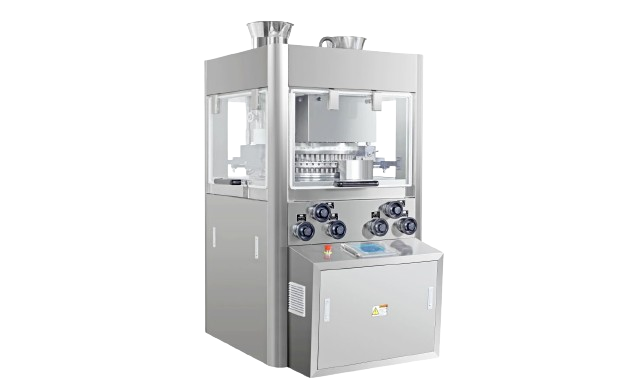
Any machine you are shown is one of three structures: single punch, single-sided rotary or double-sided rotary. Names such as pill press, pill pressing machine and tableting machine describe the same hardware, and format changes are made through the feed system and the tooling, not through a new machine category.
Turret, station count and sidedness
A single punch press holds one die and one punch set, so each stroke makes one tablet and output is stroke rate alone. A rotary press carries many stations on a turret, so output is station count multiplied by turret speed. A single-sided turret has one feed frame, one set of rollers and one discharge chute; a double-sided turret has two of each, so each station makes two tablets per revolution.
What the compression cycle fixes
Every type fills the die, meters the depth, compresses and ejects. Fill depth sets tablet weight and force sets hardness: on a single punch press both answer to one cam, while on a rotary press they are set per station and repeated. A pre-compression roller that lets trapped air escape first is fitted to specific models, not to every press in a range.
Naming: tablet press, pill press, tableting machine
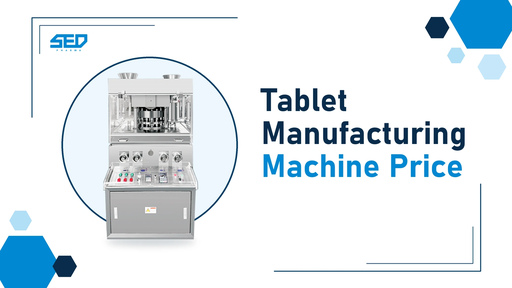
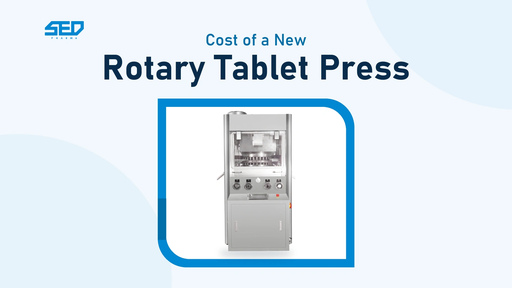
A handheld pill press sold for sampling is a bench tool, and its output says nothing about a production press. Align suppliers on station count, output band and maximum tablet diameter first. The tablet press range from SED is laid out on those three figures.
Single punch presses: trials, small batches, large tablets
A single punch press makes one tablet per stroke from one punch and die set. In the SED range that puts it between 1,200 and 5,000 tablets an hour, which covers formulation trials, sample batches and tablets too large or too thick for a rotary turret.
SED-DY-D and SED-DY-E single-punch presses
The four SED-DY-D models compared here cover tablet diameters of 12–25 mm and rated outputs of 1,200–5,000 tablets per hour. The two SED-DY-E models cover 12–20 mm and 4,500–5,000 tablets per hour.
SED-HY series: 10 to 60 T for industrial compacts
The SED-6HY-D has a loading height of 40 mm and a working pressure of 6 T. The SED-60HY-D has a loading height of 60 mm and a working pressure of 60 T. It suits industrial tablets and compacts, including materials that would attack a standard contact surface; tablet diameter follows the tooling and is confirmed per order.
Where a single punch press stops making sense
Compare how long the same batch would take on each press at a realistic running rate. Consider a rotary press when a single-punch machine can no longer meet your schedule after setup, changeovers and cleaning are included.
Choose a single punch press when the batch is a trial or a few thousand tablets and the tablet is large or unusually shaped. Move to rotary once the same tablet has to come out identical across a shift.
Single-sided rotary presses: the 6,000 to 190,000 band
A single-sided rotary press carries one feed frame, one set of compression rollers and one discharge chute, so each station makes one tablet per revolution. The two SED-Y models span 6,000 to 190,000 tablets an hour and tablet diameters from 13 to 50 mm.
SED-Y-B: 13 to 50 dies, 6,000 to 190,000 pcs/hr
The wider of the two on tablet size, up to 50 mm, which suits large tablets and formats with lettering on both faces. Station count is what you pay for here, so the question is how many dies your batch needs.
SED-Y-D: 8 to 45 dies, 14,400 to 170,000 pcs/hr
Fewer stations, a higher output floor and tablets up to 40 mm. It suits mid-volume sites with fewer format changes, where the turret holds speed for long stretches.
Single-sided or double-sided: what the second side costs
The second feed and discharge set doubles output at the same turret speed, but cleaning takes longer with two product paths, balancing the sides takes a setting procedure, and a format change touches twice as many parts.
Stay here while annual volume fits one or two shifts and formats change weekly. Move up when the press becomes the bottleneck the packing line waits on.
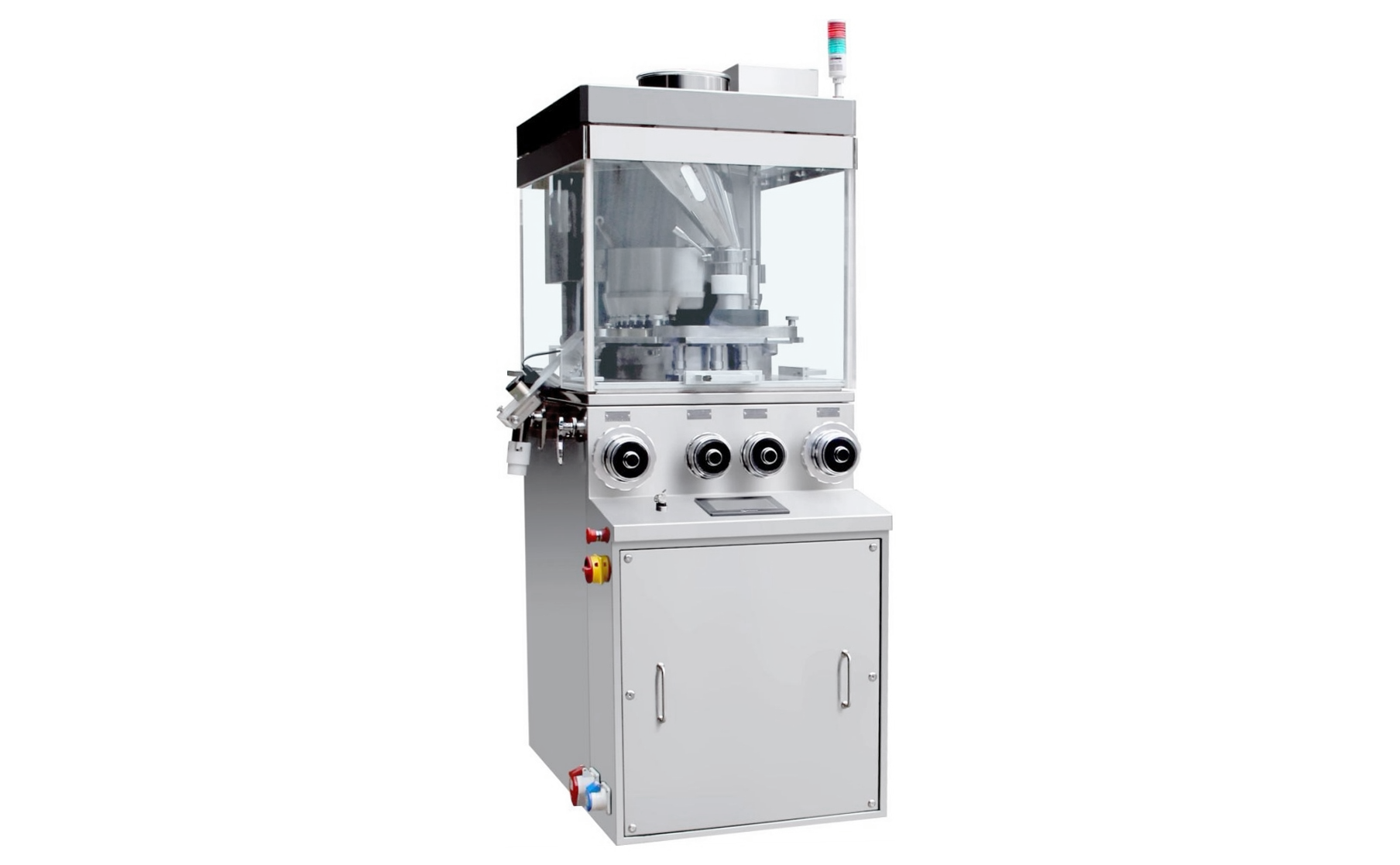
Double-sided high-speed rotary presses: 30,000 to 675,000 pcs/hr
A double-sided high-speed rotary press runs two feed and compression sets on one turret, which puts the SED-GY series between 30,000 and 675,000 tablets an hour. This tier is built for one product running across several shifts, not for a site that changes format often.
SED-GY-B: 29 to 75 dies, 30,000 to 675,000 pcs/hr
The widest output band in the range, on 11 to 25 mm tablets with 29 to 75 stations. SED lists a force-feeding system for shape pressing, pressure sensors monitoring working pressure, servo control without a hand wheel, a fully closed working area and a no-dead-angle structure for cleaning; those are SED-GY-B features as published, so check each against your quotation.
SED-GY-D: 10 to 57 dies, 43,000 to 405,000 pcs/hr
Fewer stations on the same 11 to 25 mm range, with a higher output floor. It fits a site narrowed to a few tablet sizes; if the mix still moves between 20 and 40 mm across the year, start lower.
Ask for this tier when one SKU runs three shifts and weight consistency, not flexibility, drives your scrap rate.
Multi-layer and special-format presses
Multi-layer and special-format tablets do not need a different machine frame. They need a different feed system, a different pre-compression sequence and different tooling, which is why they are confirmed per project instead of being chosen from a list.
Multi-layer and bi-layer
Two or more feed stations lay down separate powder layers with a light pre-compression between them, so the interface does not smear when the main force arrives. Layer weight is controlled per layer, total thickness has to stay inside the tooling range, and a trial agrees the layer ratio.
Effervescent and moisture-sensitive formats
An acid and a base in the same powder react as soon as humidity reaches them, so room condition, contact material and how fast the press can be stripped and cleaned matter more than output. Compression force runs lower than on a standard tablet, and sites running effervescent specify the press with the room, not after it.
Large-diameter and non-pharma compacts
The same principle covers detergent tablets, catalyst carriers and industrial compacts, where weight and crush strength matter more than documentation. Above what a single punch frame can carry, the conversation moves to a configured solution.
Send the layer structure or the format specification before asking which model to buy. We confirm whether it runs on a standard frame or needs a configured feed system, and we say so before a quotation is issued.
Comparing the types on the criteria that change the quote
Compare the three layouts by output, batch size and tablet diameter. Then confirm the tooling and options needed for your product.
This table shows when to move from one press layout to another.
| Type | Output band (pcs/hr) | Batch profile it fits | Tablet diameter | Main cost drivers | Move up when |
|---|---|---|---|---|---|
| Single punch | 1,200-5,000 | Trials, samples, oversized tablets | 12-60 mm | Tooling set, frame size, pressure rating | Output has to repeat across a shift |
| Single-sided rotary | 6,000-190,000 | Routine production, frequent changeover | 13-50 mm | Station count, tooling sets, control package | The press becomes the line bottleneck |
| Double-sided high-speed rotary | 30,000-675,000 | One SKU across several shifts | 11-25 mm | Station count, servo and pressure control, closed design | The format range has to widen again |
| Multi-layer and special format | Project specific | Two or more layers, effervescent, industrial compacts | Set by tooling | Feed stations, layer control, contact material | Output no longer fits one turret |
The cost drivers are configuration items, not a price list: SED does not publish machine prices, because two presses with the same model name can carry different station counts and documentation scope.
Selection order: five checks before you ask for a quote
Work through batch size, tablet size, material behaviour, line interfaces and documentation in that order. Changing the order usually ends with a machine that matches a specification sheet and misses the batch.
- Batch size. Convert output into tablets per hour at the shift pattern you run, then add the changeover time you expect. A press rated at 190,000 pieces an hour does not deliver that if it stops twice a shift.
- Tablet size and shape. Check the maximum against the model range, not the average: on large, thick or heavily embossed tablets the upper limit matters more than the middle of the range.
- Material behaviour. Flowability decides whether the die fills evenly, compressibility decides the force the tablet needs, and stickiness decides whether punch faces need a different finish. Abrasive or corrosive materials move the conversation to contact materials.
- Line interfaces. A press fed by dry granulation handles a different granule size than one fed by wet granulation. Downstream, dedusting, metal detection, a tablet coating line and the blister line each impose a hardness or a discharge height.
- Documentation and compliance. Ask which standard covers the compression stage, which parts are in product contact and what evidence ships with the machine. SED describes the equipment as designed to meet GMP requirements for the compression stage and states ISO-certified manufacturing and CE-marked machines; final compliance depends on installation, qualification and local regulation.

What a trial run settles that a specification sheet cannot
A rated output band and a tablet diameter range are boundaries, not results. A trial on your own granulation is the only way to see the tablet weight, hardness and reject rate that machine will actually produce.
What to send
A few kilograms of granulation, the target tablet weight and diameter, a drawing or sample tablet, the output you need per shift, and the room conditions if the product is effervescent. For multi-layer work, send both formulations.
What comes back
A trial record with the settings used, photographs, a running video on your material, and a note on anything the trial exposed, such as a fill depth near its limit. That note is worth more than the output figure.
The presses are built in a 5,500 m² facility, and SED states more than 100 R&D staff, over 20 patents and more than 300 customers on its tablet press page, with a one-year warranty plus installation and training.
If the numbers are already in front of you, send them. Batch size, tablet diameter and material get you a model recommendation, the full specification sheet, real photographs, a running video and an assessment of whether your granulation suits the machine. Tell us which documents you want with the reply, tooling drawings, a changeover sequence or a spare parts list, and we will include them. Fill in Name, E-mail, Phone and Message, with the tablet size and batch size in the message field.
Matching the type to the batch
The choice narrows once the numbers are on the table. Under a few thousand tablets an hour with a large or experimental tablet, a single punch press does the job and keeps tooling costs low. Between 6,000 and 190,000, a single-sided rotary press covers routine production without charging you for changeover time you don’t need. Above that, with one product running several shifts, the double-sided high-speed tier earns its place through output and monitoring.
What none of these tiers can tell you is whether your granulation runs on them. A trial answers that, and it starts with three numbers: batch size, tablet diameter and material.
Frequently asked questions
Can one tablet press make both round and irregular tablets?
Yes, provided the tooling matches the shape and the turret is specified for it. Long or deeply embossed shapes often need force feeding so the die fills before compression; the limits are maximum diameter, thickness and how far the shape sits from the turret centre.
Why do two quotes for the same tablet press differ?
Usually because they are not the same machine. Station count, tooling sets, control package, contact material and documentation scope all move the figure, and a lower quote often leaves tooling or installation out.
What tooling and spare parts should be ordered with the machine?
One complete tooling set per tablet size and shape you plan to run, plus a second set for the highest-volume format so production continues while the first is polished or replaced. Then ask for the recommended wear parts list for that model.